Algarve Cycling Climbs: The Best Road Cycling Ascents
The Algarve might be famous for beaches, golf courses and sunshine, but get on a road bike and head inland and you’ll discover a very different side of southern Portugal.
For cyclists, some of the most interesting terrain is found away from the coast.
The Algarve cycling climbs range from long mountain ascents towards the highest points in the region to short, sharp inland roads that can hurt far more than their modest length suggests.
And that’s one of the things I enjoy most about riding here.
You don’t need to spend the entire day climbing.
From a base around Portimão or Alvor, we can combine flatter coastal riding, rolling countryside and serious climbing depending on what kind of day you want.
If you love climbing, though, there are several roads you really should experience.
Foia: The Algarve’s Big One
You can’t really discuss Algarve cycling climbs without starting with Foia.
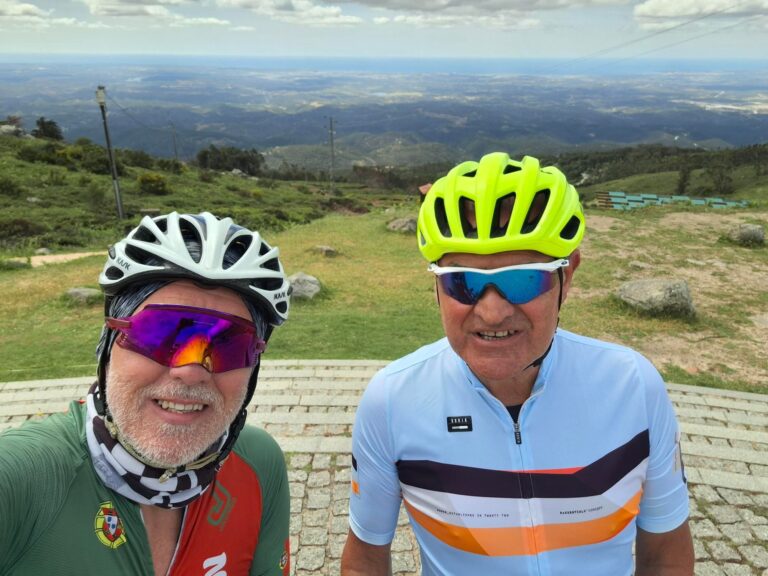
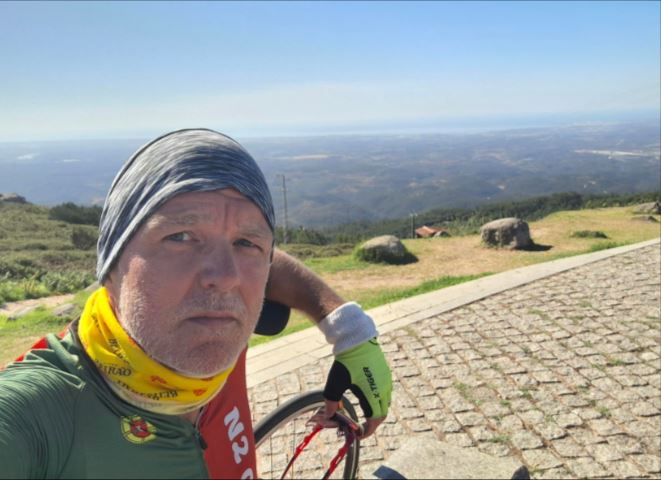
At around 900 metres above sea level, Foia is the highest point in the Algarve and the obvious target for cyclists looking for a proper mountain ride.
The mountain sits above Monchique in the Serra de Monchique, dominating much of the western Algarve skyline.
From the coast, it can look a very long way up.
That’s because it is.
Depending on where you start and which roads you use, a ride towards Foia can provide a substantial amount of climbing.
But simply quoting gradients and elevation doesn’t really explain why I like riding here.
The landscape changes as you climb.
The busy coastal Algarve disappears behind you and you’re suddenly riding through a much greener, more mountainous environment.
On a clear day, the views from higher ground stretch for miles.
It feels completely different from the Algarve many visitors imagine.
Climbing to Monchique
Monchique itself sits below Foia and makes an excellent cycling destination even if you don’t continue all the way to the summit.
There are several ways of approaching the area, and that’s important.
The best cycling route isn’t necessarily the most obvious driving route.
When I’m planning a ride, I’m interested in more than simply getting from A to B.
Traffic, road surface, weather, wind, rider ability and how enjoyable the road actually is all matter.
That’s particularly important around popular destinations such as Monchique.
A cyclist who simply follows the route suggested by a general navigation app can have a very different experience from somebody using roads chosen specifically for cycling.
It’s one of the advantages of riding with someone who knows the area.
Our Algarve Cycling Holidays are built around exactly this idea: you arrange your accommodation around Portimão or Alvor, and we build the riding around you.
Foia Isn’t Just About Reaching the Top
There’s a temptation with famous climbs to think only about the summit.
I think that’s a mistake.
The journey is usually more interesting than standing next to the sign at the top.
The Serra de Monchique contains roads where you can settle into a rhythm and simply climb.
There are also quieter alternatives and connecting roads that can turn a straightforward ascent into a much more interesting day.
And then you’ve got the descent.
A good Algarve climbing ride needs to work in both directions.
Descending safely matters just as much as climbing ability, particularly when gradients, corners and road surfaces change.
Take your time.
You’ve earned the descent, but you don’t need to race it.
The Climbs Around Silves
Head inland towards Silves and another excellent network of cycling roads opens up.
Silves itself is one of the Algarve’s most distinctive historic towns, with its castle visible long before you reach the centre.
But from a cycling perspective, the surrounding countryside is at least as interesting as the town.
Move away from the main roads and you’ll find rolling terrain with repeated climbs and descents.
These aren’t necessarily climbs that appear on international cycling bucket lists.
That’s exactly why I like them.
You can put together a route where the climbing gradually accumulates without spending the whole day grinding up one enormous mountain.
For riders who enjoy undulating roads, this can be better than simply riding up Foia and back down again.
Short Algarve Climbs Can Be Deceptive
Don’t assume that a short climb is an easy climb.
The Algarve is very good at hiding little roads that suddenly point upwards.
You can be rolling comfortably through the countryside and then turn onto a road where the gradient changes completely.
These short ramps are one of the reasons average gradient figures don’t tell the whole story.
A route might look relatively gentle when you examine the overall elevation.
On the bike, repeated short climbs can gradually wear down your legs.
That’s especially true in warm weather.
The Algarve doesn’t need Alpine-sized mountains to give you a hard cycling day.
If that’s what you want, we can certainly find one.
Caldas de Monchique
The area around Caldas de Monchique offers another side to riding in the hills.
The roads wind through a much greener landscape than you’ll find nearer the coast.
There is shade in places, vegetation changes noticeably and the temperature can feel different as you gain altitude.
It’s also an area where route choice matters.
Rather than treating every ride as a mission to reach the highest possible point, you can use the surrounding roads to create a climbing day appropriate to the riders.
That might mean Foia.
It might not.
A memorable cycling holiday doesn’t require you to destroy yourself every morning.
The Western Algarve Has More Than Monchique
Foia understandably receives most of the attention because it’s the Algarve’s highest point.
But concentrating exclusively on Foia misses much of what makes road cycling in the western Algarve so good.
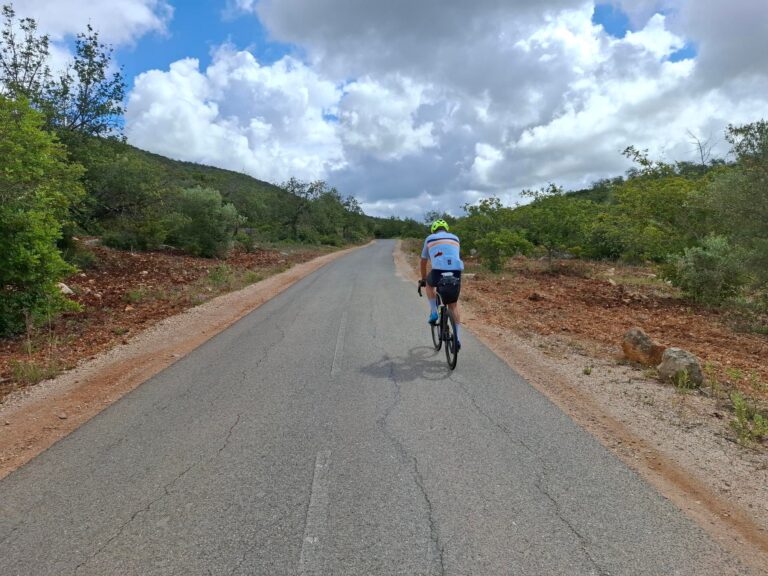
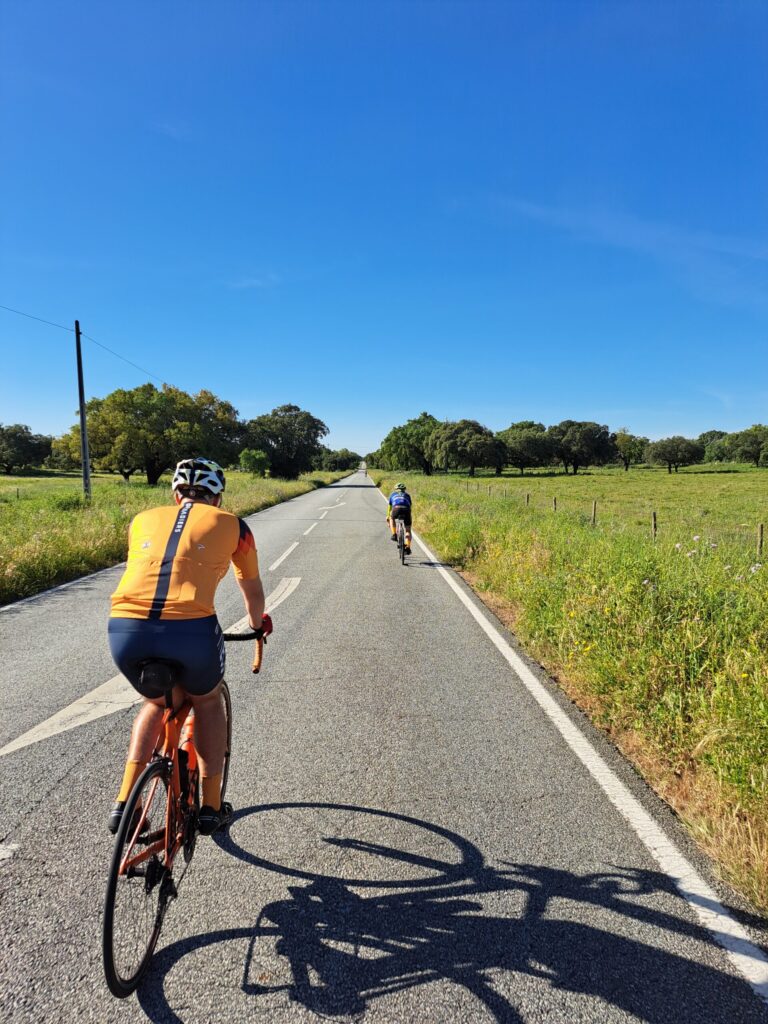
Head west and inland from the coastal resorts and there are countless combinations of rolling roads, short climbs and quieter countryside.
Some days you might accumulate considerable elevation without ever riding one famous named ascent.
Those are often some of my favourite rides.
You stop thinking about ticking off a landmark and start enjoying the roads themselves.
For a broader look at the riding in this part of Portugal, our guide to Road Cycling in the Western Algarve is coming later in this series.
What Makes a Good Algarve Cycling Climb?
For me, it isn’t simply gradient.
A great climb needs more than a big number on a cycling computer.
I want a road that makes the effort worthwhile.
That might mean beautiful scenery.
It might mean very little traffic.
It might be a fantastic descent waiting on the other side.
Sometimes it’s a café or village where you can stop afterwards.
And sometimes it’s simply that feeling of turning onto a road that seems made for a bicycle.
That’s the difference between finding climbs on a map and actually knowing an area by bike.
How Hard Is Climbing in the Algarve?
It can be as easy or as difficult as you want to make it.
That’s one of the region’s strengths.
A strong rider looking for a serious training day can combine longer climbs with repeated elevation and create a demanding route.
A recreational road cyclist can enjoy a much gentler day with one worthwhile climb surrounded by easier terrain.
You don’t have to ride Foia.
You don’t have to chase Strava times.
And you certainly don’t have to climb at somebody else’s pace.
For private Algarve riding, the route should suit the people actually riding it.
Gearing for Algarve Climbs
Bring gearing that allows you to climb comfortably.
What that means depends on your fitness, bike and preferred cadence, but there’s little benefit in arriving over-geared because you expected the Algarve to be flat.
It isn’t.
A compact or semi-compact road setup combined with an appropriate cassette will suit many visiting cyclists.
Strong riders may choose something different.
The important point is to choose gearing for the riding you’re actually going to do rather than trying to prove something.
You’re here to enjoy the week.
What About E-Bikes?
Suitable road or performance e-bikes can open the Algarve’s hillier terrain to riders who might otherwise avoid it.
That’s particularly useful when people of different abilities want to ride together.
The objective isn’t necessarily for everybody to produce identical power.
It’s to allow a group to enjoy the same roads.
If you’re bringing or hiring an e-bike for longer or hillier rides, battery range is obviously something to consider.
Charging overnight should also be part of your planning.
When Is the Best Time for Algarve Climbing?
Spring and autumn are particularly attractive.
Temperatures are generally much better suited to sustained climbing than during the hottest part of summer.
The landscape can also look very different through the seasons.
Summer riding is possible, but serious climbing in strong heat requires more thought.
Early starts, hydration and route choice become increasingly important.
We covered this in much greater detail in our guide to the best time of year for cycling in the Algarve.
Don’t Underestimate the Sun
On a long climb you’re travelling relatively slowly.
That means less cooling airflow.
If the road is exposed, the sun can become a bigger factor than the gradient.
Hydration is essential.
So is eating properly.
It’s surprisingly easy to concentrate on reaching the top of a climb and forget that you’ve still got several hours of cycling ahead.
The objective is not just reaching the summit.
It’s finishing the entire ride feeling good.
Climb at Your Own Pace
One of the quickest ways to ruin a long climbing day is trying to follow somebody significantly stronger than you.
Let them go.
A long climb rewards rhythm.
Find a sustainable effort and stick with it.
On our private Algarve rides, there’s no reason for somebody to feel pressured into riding beyond their ability.
We’re not running a race.
If the group needs to split temporarily on a climb, we regroup.
Simple.
Descending Algarve Roads
What goes up eventually comes down.
And Algarve descents can be fantastic.
But they’re public roads.
You need to expect vehicles, corners, changing surfaces and occasional unexpected hazards.
Look through bends where visibility allows, control your speed before the corner rather than halfway through it and leave yourself a margin for error.
If you’re unfamiliar with the road, don’t descend as though you’ve ridden it a hundred times.
I would rather wait two minutes at the bottom than spend the afternoon dealing with an accident.
Where Should Cyclists Stay?
For the riding we offer, Portimão and Alvor make particularly practical bases.
You’re close to the coast but have excellent access towards the inland roads and Monchique.
That gives us flexibility.
One day can be mountainous.
The next can be rolling.
Another can head towards quieter western roads.
We’ve put together a separate guide explaining where to stay for a cycling holiday in the Algarve.
You book and pay for your own accommodation, which means you’re free to choose the hotel, apartment or accommodation style that suits you.
We concentrate on the cycling.
You Don’t Need a Fixed Route Before You Arrive
This is something I think makes the Algarve particularly well suited to private guided cycling.
Weather changes.
Wind direction changes.
Legs change too.
A route that sounded brilliant six months earlier might not be what you want after three consecutive days on the bike.
That’s why I prefer flexibility.
Tell me roughly what you enjoy riding, how fit you are and what you’d like to get from the trip.
Then we can shape the riding accordingly.
If you wake up with tired legs, we don’t need to force a huge climbing day simply because it appeared on an itinerary.
And if you’re feeling fantastic and want something harder?
The hills aren’t going anywhere.
Are the Algarve Cycling Climbs Worth It?
Absolutely.
But not simply because Foia reaches around 900 metres.
The real attraction is the variety.
You can leave the coastal Algarve behind and be climbing through completely different scenery surprisingly quickly.
You can tackle the region’s highest mountain, spend a day accumulating elevation over quiet inland roads or combine one good climb with villages, cafés and easier riding.
That’s what makes the Algarve interesting as a road cycling destination.
The climbing doesn’t dictate the holiday.
It gives us more options.
And if climbing is exactly what you’ve come to Portugal for, there are plenty of roads waiting.