Cycling Portugal North to South: The Ultimate N2 Ride
Cycling Portugal north to south is one of those adventures that sounds beautifully simple.
Start at the top of the country.
Ride south.
Stop when you reach the Algarve.
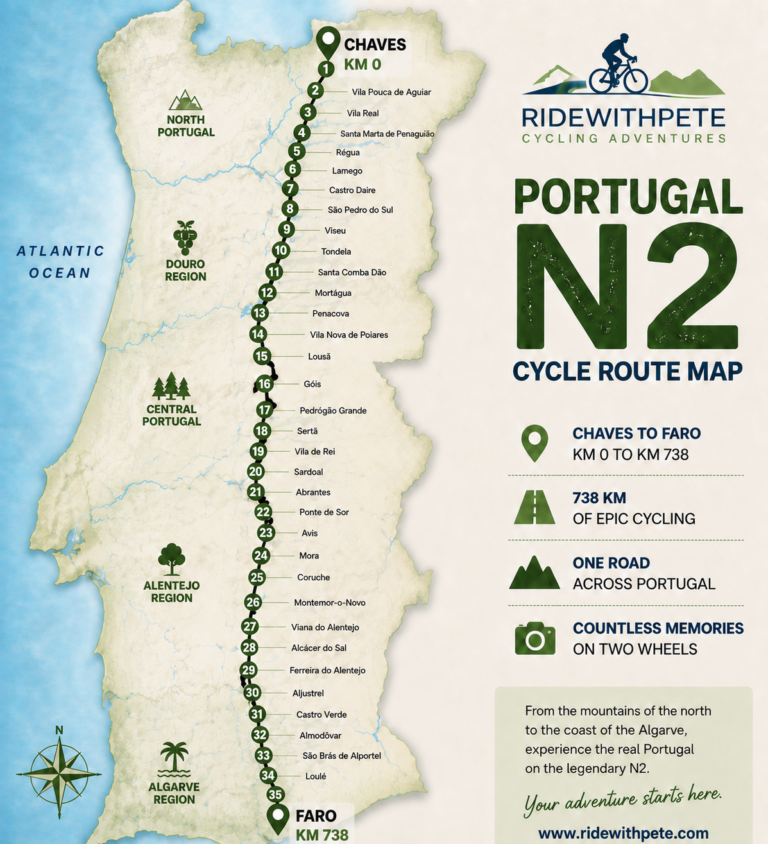
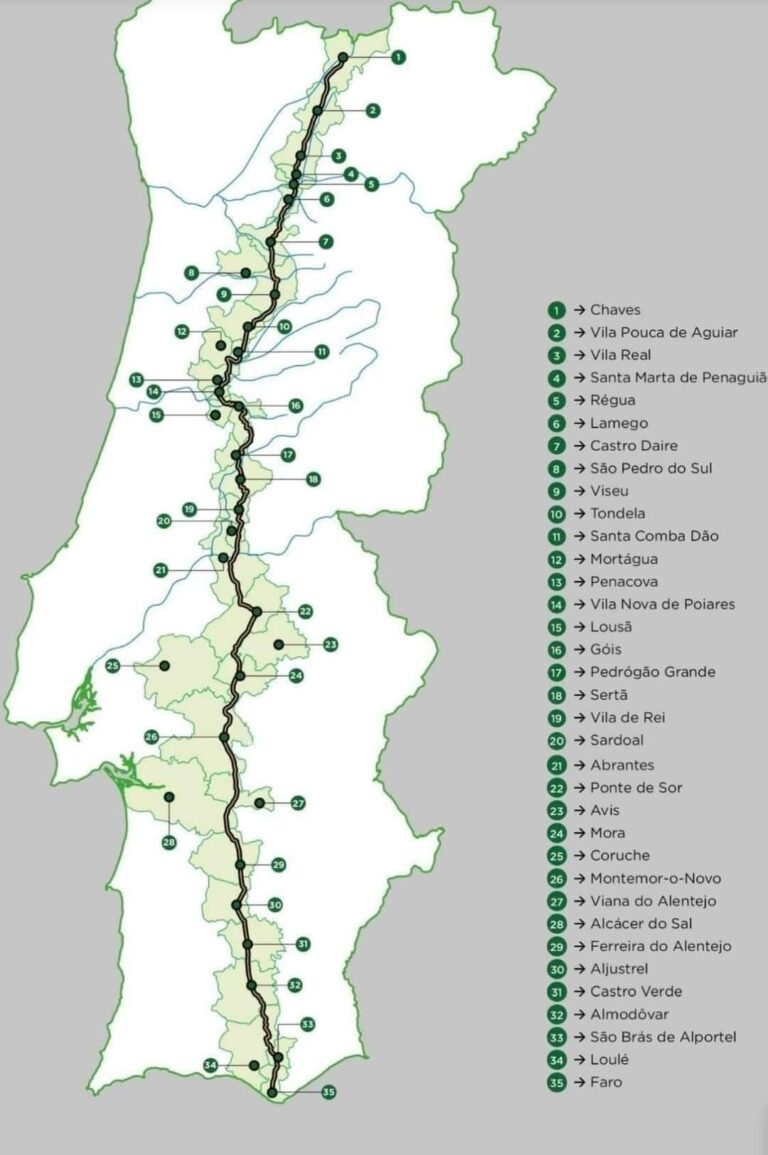
Portugal’s legendary Estrada Nacional 2 (N2) makes that possible, running 738 km from KM 0 in Chaves to KM 738 in Faro.
But there’s more to choosing north to south than simply following tradition. It’s the direction we prefer at RideWithPete for several practical reasons — including one that can make an enormous difference when you’re spending seven days on a bicycle.
The wind.
Why Cycle Portugal From North to South?
Portugal’s N2 can obviously be ridden in either direction.
But we ride Chaves to Faro.
Firstly, there’s something naturally satisfying about beginning among the mountains and greener landscapes of northern Portugal and gradually making your way towards the sunshine and warmer landscapes of the Algarve.
The scenery changes almost continuously.
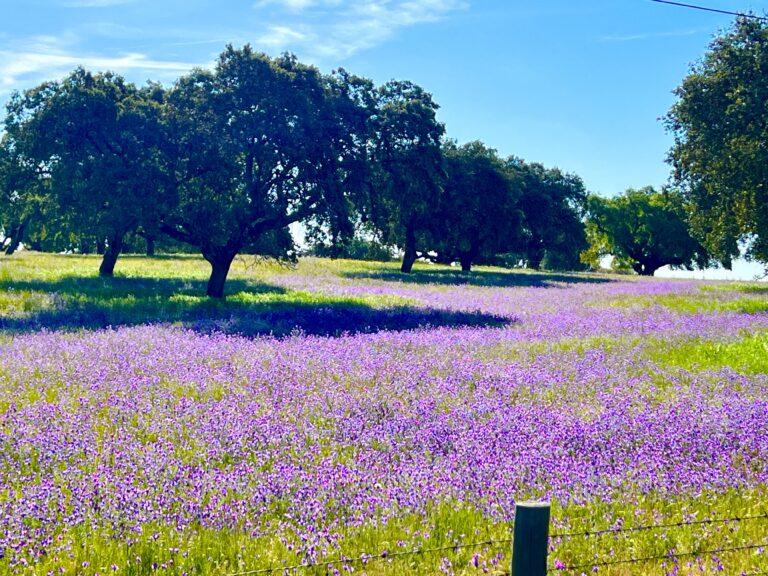
You travel through the north, the Douro region and central Portugal before the landscape opens into the huge skies and cork-oak country of the Alentejo.
Eventually you cross into the Algarve and continue towards Faro.
By the finish, it genuinely feels as though you’ve travelled through an entire country rather than simply completed a long bike ride.
But there’s also a practical reason for choosing this direction.
The Wind Matters More Than You Might Think
Ask any cyclist about wind and you’ll probably get a stronger reaction than if you ask them about hills.
You can see a climb coming.
A headwind can spend hours quietly draining your legs.
Over a 738 km multi-day ride, that matters.
Portugal frequently experiences winds with a northerly or northwesterly component, particularly during the warmer part of the year.
Riding from Chaves towards Faro therefore gives us the opportunity to benefit from those winds rather than deliberately spending hundreds of kilometres riding against them.
Notice I said opportunity.
There is absolutely no guarantee of seven days of tailwinds.
Portugal’s weather is influenced by Atlantic fronts, local geography, temperature and coastal effects. Wind direction can change significantly during a single trip.
But if I’m choosing which direction to ride an entire country, I’d rather put the prevailing wind odds on my side.
Spring: April and May
Spring is one of our favourite periods for cycling the N2.
As conditions become warmer, northerly and northwesterly airflow can provide some very welcome assistance when travelling south.
This can become particularly noticeable once you reach the more exposed landscapes further down the country.
Northern Portugal can be less predictable.
Atlantic weather systems can bring westerly and southwesterly winds, sometimes accompanied by rain. Catch the wrong weather system and the wind can certainly be against you.
As you approach the Algarve, local coastal effects can change conditions again.
So does April or May guarantee a tailwind?
Definitely not.
But over the course of a complete north-to-south journey, spring gives us a reasonable chance of having the wind help rather than hinder us.
What About September and October?
Autumn is another excellent period for cycling Portugal, but the wind can become more unpredictable.
Late September can bring beautiful calm conditions and pleasant temperatures.
As autumn progresses into October, Atlantic weather systems become increasingly influential. Westerly and southwesterly winds become more of a possibility, potentially producing crosswinds or headwinds on sections of the journey.
On the other hand, temperatures through the Alentejo are generally far more comfortable than during the height of summer.
It’s a trade-off.
That’s why we don’t choose N2 dates based on one factor alone. Temperature, rainfall, daylight and wind all contribute to whether conditions are likely to make for an enjoyable cycling trip.
You can read more in our guide to the best time of year to cycle Portugal’s N2.
Does North to South Guarantee a Tailwind?
No.
And I’d be very suspicious of anybody selling an N2 cycling holiday who promised you one!
Over seven days and 738 km, the weather will do whatever the weather decides to do.
You might spend an afternoon enjoying a fantastic push from behind and wake the following morning to discover the wind has completely changed direction.
But cycling is about playing the percentages.
If prevailing conditions give us a better chance of assistance when travelling towards Faro, that’s the direction I’d rather ride.
It’s one of several reasons our N2 adventures start at KM 0 in Chaves.
What Is Cycling the N2 Actually Like?
Don’t mistake travelling south for travelling downhill.
Portugal isn’t flat.
Northern Portugal contains some serious climbing, and the rolling terrain continues as you move through the country.
There are wonderful descents too, but fitness for the N2 isn’t simply about whether you can ride a particular distance.
It’s about doing it repeatedly.
Ride.
Recover.
Sleep.
Then get back on the bike the following morning.
Our guide to how hard it is to cycle Portugal’s N2 looks at the challenge in more detail.
How Long Does Cycling Portugal North to South Take?
There’s no compulsory schedule.
Some cyclists treat the N2 as an endurance challenge and complete it very quickly. Others take considerably longer and build rest days and sightseeing into their journey.
For a fit recreational cyclist looking for a proper challenge while still enjoying Portugal, seven riding days works extremely well.
But there’s an important distinction between riding 738 km in seven days and creating seven good cycling days.
Simply dividing 738 by seven isn’t how we plan the N2.
Elevation, sensible stopping points, accommodation, food, water and how one day’s effort affects the next all influence the itinerary.
We’ve spent years riding and refining our approach to the route, and that’s knowledge we deliberately keep within our guided and self-guided products rather than publishing the complete itinerary online.
You can still get a good feel for the journey in our Cycling Portugal’s N2 in 7 Days guide.
What Does the North-to-South Route Look Like?
The N2 effectively creates a spine through Portugal’s interior.
From Chaves, it works its way south through constantly changing landscapes until eventually reaching Faro.
We’ve created a separate Portugal N2 Cycle Route Map showing the overall journey from KM 0 to KM 738.
What we deliberately don’t publish on that map are our seven overnight stage points.
A map tells you where the N2 goes.
Planning where you should stop each day is a different matter.
Do You Need GPS Navigation?
I certainly recommend it.
Following one road sounds straightforward until you’re passing through towns, negotiating junctions or trying to make decisions after several hours in the saddle.
Reliable GPX navigation lets you concentrate on riding.
For our self-guided route, we use seven individual GPX files, each corresponding to a carefully planned day’s cycling.
We’ve explained more about that in our Portugal N2 GPX Files guide.
Guided or Self-Guided?
This depends on how much of the planning you want to do yourself.
Some cyclists enjoy researching every detail.
If that’s you, there’s nothing stopping you from building your own routes, finding accommodation and organising the entire journey independently.
Other riders want the freedom of cycling independently but don’t want to spend weeks working everything out.
That’s what our N2 Self-Guided Adventure Pack is for.
It contains our seven GPX routes, seven elevation profiles, planned stages, accommodation recommendations and the practical route knowledge we’ve developed from actually riding the N2.
And if you’d rather have the entire adventure organised and supported, you can ride the N2 with us on a guided RideWithPete tour.
Either way, the objective is the same.
From KM 0 to KM 738
There are longer cycling routes.
There are harder cycling routes.
But there’s something wonderfully satisfying about crossing an entire country under your own power.
You start beside KM 0 in Chaves with northern Portugal stretching out ahead of you.
Day by day, the landscape changes.
The kilometres accumulate.
Faro gets closer.
And hopefully, every now and again, you feel that northerly wind pushing at your back and realise there’s another good reason you chose to ride Portugal in this direction.
Eventually there’s nowhere further south to ride.
You’re standing beside KM 738 in Faro.
Turn around and look north.
You just cycled Portugal.