Training for Portugal’s N2: How Fit Do You Need to Be?
How Hard Is Cycling Portugal’s N2?
The N2 is challenging, but it shouldn’t be thought of as seven days of relentless suffering.
The terrain changes considerably as you travel south.
Northern and central Portugal contain some substantial climbing and long rolling sections. Further south, the landscape gradually opens up before the route eventually reaches the Algarve.
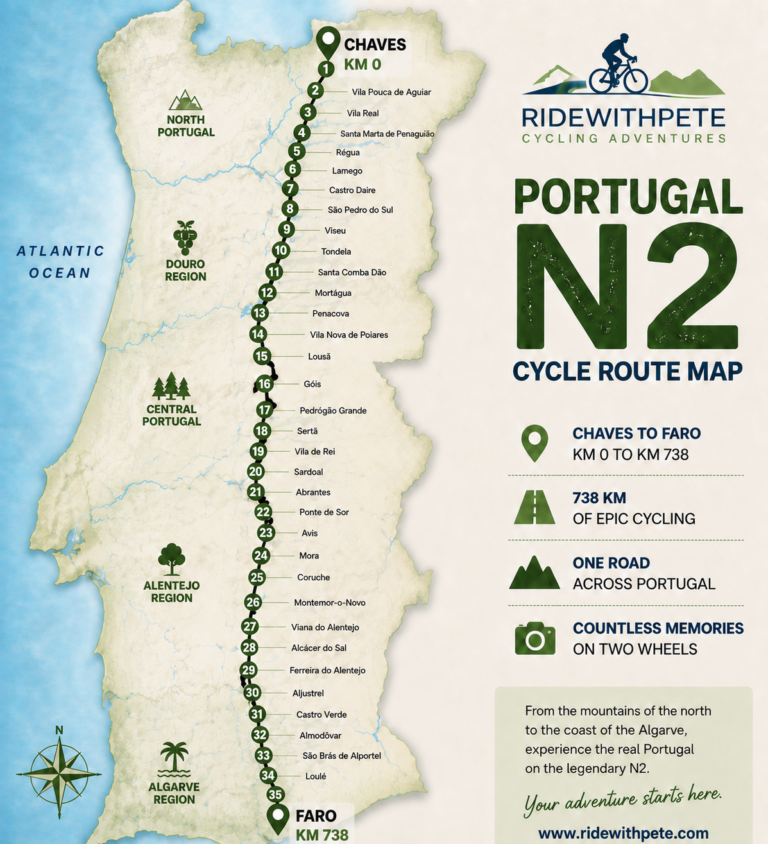
Over the complete journey, however, you are still cycling 738 km in seven days.
That’s an average of a little over 100 km per riding day.
Some days will feel considerably harder than others.
Weather also matters.
Heat, wind or rain can transform a day that looks relatively straightforward on paper.
That’s why looking only at distance doesn’t tell the whole story.
If you’d like a broader overview of the challenge, read our complete guide to cycling Portugal’s N2.
So How Fit Do You Actually Need to Be?
Here’s perhaps the easiest way to judge it.
If a 100 km road ride currently sounds completely impossible, you probably have some work to do before tackling the N2 in seven days.
If you can already comfortably ride 70–100 km, the challenge becomes much more manageable.
But there’s an important distinction.
Being able to ride 100 km once doesn’t necessarily mean you’re ready to ride similar distances repeatedly for a week.
That is what your training needs to address.
Our guided N2 rides are not races.
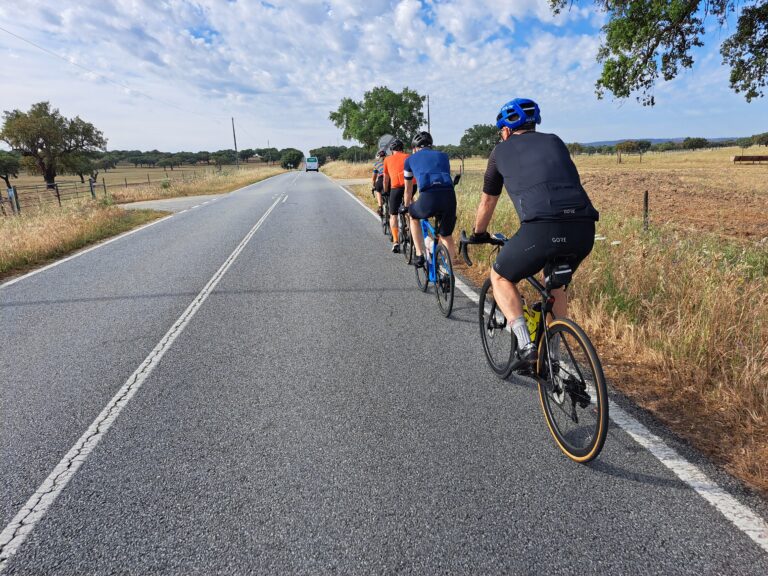
The normal moving pace is approximately 21–24 km/h, adjusted for terrain, conditions and the group.
There is no prize for reaching Faro first.
The objective is for the group to complete one of Europe’s great road-cycling journeys and enjoy Portugal along the way.
Your training should therefore concentrate much more on sustainable endurance than outright speed.
The Most Important Part of Training: Back-to-Back Riding
If I could choose just one type of preparation for the N2, it would be this:
Ride on consecutive days.
Many recreational cyclists have a familiar routine.
Perhaps you ride 70 km on Sunday.
You get home tired, shower, eat everything in sight and put the bike away until Wednesday.
That’s perfectly good recreational cycling.
But the N2 doesn’t give you Wednesday off.
Your body needs to become accustomed to getting back onto the bike when yesterday’s ride is still in your legs.
You don’t need to ride 100 km every day in training.
Instead, gradually introduce consecutive riding.
For example:
Saturday: 60–80 km
Sunday: 40–60 km
As your fitness develops, you might occasionally progress towards:
Friday: 40–50 km
Saturday: 70–90 km
Sunday: 50–70 km
The precise numbers aren’t important.
What matters is teaching your body to recover while continuing to ride.
That is much more specific preparation for the N2 than smashing yourself to pieces on one enormous training ride.
Don’t Ignore Time in the Saddle
Your legs aren’t necessarily the first part of your body to complain.
Hands.
Neck.
Shoulders.
Back.
And, inevitably, your backside.
Spending several hours on a bicycle day after day exposes small bike-fit and comfort problems that might barely be noticeable during shorter rides.
A saddle that feels perfectly acceptable for two hours might become considerably less friendly after five.
And the following morning you have to sit on it again.
This is another reason long training rides matter.
You’re not simply training your cardiovascular system.
You’re conditioning your whole body to spending long periods on a bicycle.
It also gives you time to identify problems before arriving in Portugal.
Build Your Distance Gradually
One of the biggest mistakes when training for Portugal N2 would be suddenly doubling your normal mileage.
If your longest current ride is 40 km, don’t decide that next weekend must be 100 km.
Build gradually.
Consistency is far more useful than one heroic ride followed by a week recovering from it.
Someone beginning with moderate cycling fitness might progress from regular 40–50 km rides towards 60 km, then 70 km, then perhaps 80–100 km over a period of weeks.
There is no magic weekly mileage that guarantees you will complete the N2.
Everyone responds differently to training.
Age, cycling history, available training time, terrain and general fitness all matter.
The goal is simple:
Make long rides increasingly normal rather than exceptional.
Train on Hills
If you live somewhere flat, climbing can come as a shock.
You don’t need mountains on your doorstep, but include climbing wherever possible.
Find hills and ride them.
If they’re short, ride them more than once.
The objective isn’t necessarily to attack every climb.
In fact, learning to climb slowly and sustainably is probably more useful.
One of the easiest ways to ruin a long cycling day is attacking the first significant climb as though you’re trying to win a stage of the Tour de France.
Ride within yourself.
Use your gears.
Let other people disappear up the road if they want to.
There are another few hundred kilometres waiting.
Speed Matters Less Than You Think
Cyclists can become obsessed with average speed.
For N2 preparation, I’d worry much less about it.
A rider capable of maintaining a steady effort for five hours is often better prepared for a multi-day tour than someone who can ride incredibly hard for two hours before running out of energy.
You need to develop a pace you can sustain.
On the RideWithPete guided N2 tour, the normal moving pace is around 21–24 km/h, depending on terrain, weather and the group.
Nobody expects identical speeds on every section.
Twenty-three kilometres per hour across rolling terrain is very different from 23 km/h climbing through the Portuguese mountains.
What matters is being comfortable riding steadily as part of the group.
Learn to Eat While You Ride
Fitness isn’t much use if you forget to fuel it.
Long-distance cycling requires energy.
Many riders make the mistake of waiting until they’re hungry before eating.
By then, you’ve often left it too late.
Training rides are the perfect opportunity to learn:
- what foods you tolerate while cycling;
- how frequently you need to eat;
- how much you need to drink;
- what happens to your appetite after several hours;
- and what works for you in warmer conditions.
Don’t arrive at the N2 with an entirely new nutrition strategy you’ve never tested.
Your training rides are rehearsals.
Use them.
Recovery Is Part of Training Too
More isn’t always better.
Your body becomes stronger when it has an opportunity to recover from training.
That means sleep matters.
Nutrition matters.
Rest days matter.
If every ride becomes an exhausting test of willpower, you’re probably making the process harder than necessary.
Most N2 preparation should feel controlled.
There will naturally be difficult days, particularly as your distances increase, but you shouldn’t spend months permanently exhausted.
You are trying to arrive in Chaves fit and fresh, not fit and already worn out.
Do You Need a Training Plan?
Not necessarily.
Some cyclists love structured training plans, power targets and carefully calculated training zones.
Others would rather throw their Garmin into the Atlantic than spend three months staring at power numbers.
Both can cycle the N2.
A structured programme can certainly help, particularly if you enjoy training that way.
But recreational cyclists can make enormous progress simply through consistent riding.
For many riders, a sensible approach might include:
- one or two shorter rides during the week;
- one longer weekend ride;
- regular climbing;
- gradually increasing distance;
- and increasingly frequent back-to-back rides as the trip approaches.
The important word is consistent.
Three months of sensible cycling beats a frantic fortnight of panic training.
How Long Should You Train for the N2?
That depends entirely on where you’re starting.
An experienced cyclist already riding several times each week might simply need to adjust their existing training towards longer and consecutive rides.
Someone returning to cycling after a long break will need considerably longer.
If possible, don’t leave your preparation until the last few weeks.
Giving yourself several months allows you to increase the workload gradually without turning every weekend into a fitness test.
It also leaves room for normal life.
Work gets busy.
Weather turns horrible.
Family commitments appear.
Sometimes you simply don’t feel like riding.
Starting early gives you breathing room.
A Simple 12-Week N2 Training Framework
This isn’t intended as a rigid coaching programme.
Think of it as a practical framework.
Weeks 1–4: Build consistency
Concentrate on riding regularly.
Aim for a mixture of shorter rides and one longer ride each week.
Don’t chase huge distances yet.
The objective is simply to make cycling a normal part of your week.
Weeks 5–8: Increase endurance
Begin extending the longer ride.
Add more climbing.
Start introducing occasional consecutive-day riding.
This is where you should begin noticing that distances which once felt significant are becoming normal.
Weeks 9–10: Make it N2-specific
This is where back-to-back riding becomes particularly valuable.
Try a weekend with two substantial rides.
If practical, occasionally ride three consecutive days.
You don’t need to replicate the entire N2.
You’re simply teaching your body what repeated endurance feels like.
Weeks 11–12: Don’t try to become Superman
The work should already have been done.
Reduce the temptation to squeeze in one gigantic last-minute ride.
Maintain your fitness, keep the legs moving and arrive ready to cycle.
You gain very little from turning up in Portugal exhausted because you completed your biggest training week immediately before travelling.
What About E-Bikes?
Suitable e-bikes are welcome on our N2 tour.
But an e-bike doesn’t completely remove the need for preparation.
You are still spending long hours on a bicycle.
You still need bike-handling ability.
You still need physical comfort.
And you need a bicycle and battery capable of dealing with the required distance and climbing.
Battery management becomes part of the preparation too.
An e-bike can make the N2 accessible to riders who might otherwise struggle with the climbing or daily distances, but it isn’t a substitute for arriving prepared.
Your Bike Needs Training Too
Don’t spend months preparing your body and ignore the machine underneath it.
Before the N2, make sure your bike is comfortable, reliable and properly maintained.
Pay particular attention to:
- tyres;
- brakes;
- drivetrain;
- gearing;
- saddle comfort;
- cleat position;
- and general bike fit.
If you’re planning changes to your bike, make them before the trip.
The first morning in Chaves isn’t the ideal moment to discover that your new saddle hates you.
You should also be comfortable dealing with ordinary roadside issues such as changing an inner tube.
Basic tools are carried on our guided trip, but riders should understand the fundamentals of their own equipment and carry suitable personal spares.
Test Your Clothing Before Portugal
The same principle applies to clothing.
Don’t save brand-new cycling shorts for the N2.
Ride in them first.
Test your shoes.
Test your gloves.
Test your rain jacket.
Know where clothing rubs after several hours.
Know whether your pockets actually hold everything you intend to carry.
Small irritations have an impressive ability to become enormous irritations after five consecutive days.
We will cover this in much more detail in our upcoming Portugal N2 packing list, but the basic rule is simple:
Don’t make the N2 the first test of important equipment.
Mental Fitness Matters
There will probably be a point during seven days when you don’t feel wonderful.
Perhaps the weather changes.
Perhaps yesterday’s climbing remains in your legs.
Perhaps you’ve simply reached that moment where another hill isn’t particularly welcome.
That’s part of long-distance cycling.
The ability to relax, settle into a sustainable rhythm and keep turning the pedals matters.
This is another advantage of a guided group.
You’re sharing the journey.
There is conversation, encouragement and the knowledge that everyone is heading towards the same KM 738 finish in Faro.
Sometimes that makes an enormous difference.
How Do You Know When You’re Ready?
There isn’t a single fitness test.
But before travelling, I’d want you to be able to answer yes to most of these:
Can you comfortably ride for several hours?
Have you completed rides approaching the kind of distances you’ll encounter?
Have you ridden on consecutive days?
Are you comfortable climbing at your own sustainable pace?
Can you eat and drink properly while riding?
Is your bike comfortable after several hours?
Are you comfortable riding steadily with other cyclists?
Do you actually enjoy long days on a bike?
If the answer is yes, you’re probably much closer to being N2-ready than you think.
You Don’t Need to Be the Strongest Rider
This is worth repeating.
The N2 isn’t reserved for elite cyclists.
You don’t need racing speed.
You don’t need enormous power numbers.
And you certainly don’t need to be the fastest cyclist in your local club.
You need realistic fitness, preparation and the determination to ride sensibly for seven consecutive days.
The aim isn’t to prove how fast you can cross Portugal.
It’s to experience it.
From the northern landscapes around Chaves through the changing heart of the country and eventually down towards Faro, the N2 is the sort of ride where finishing matters considerably more than your average speed.
Want to Ride the N2 With Us?
If reading this has made you think:
“Actually, I could do this.”
Good.
That’s exactly the point.
Respect the challenge, train properly and give yourself enough time to prepare.
Then come and ride it.
You can see the complete guided N2 cycling tour here or check our 2027 N2 tour dates and availability.
Prefer to tackle Portugal independently? Take a look at our N2 self-guided cycling option.
However you choose to ride it, don’t let the distance intimidate you into thinking the N2 is only for racing cyclists.
738 km is a serious challenge.
But with sensible training for Portugal N2, it’s a challenge ordinary, committed road cyclists can prepare themselves to complete.
And when you eventually reach that KM 738 marker in Faro, all those training rides will suddenly make sense.