What Bike Do You Need to Cycle Portugal’s N2?
If you’re preparing to cycle Portugal’s N2, it’s easy to become obsessed with choosing the perfect bike.
Carbon or aluminium? Race bike or endurance bike? Disc or rim brakes? 28 mm or 32 mm tyres? Electronic or mechanical gears?
The good news is that you don’t need an exotic bike to cycle the N2.
What you do need is a reliable, comfortable bike that fits you properly, has sensible gearing and is suitable for spending seven consecutive days on the road.
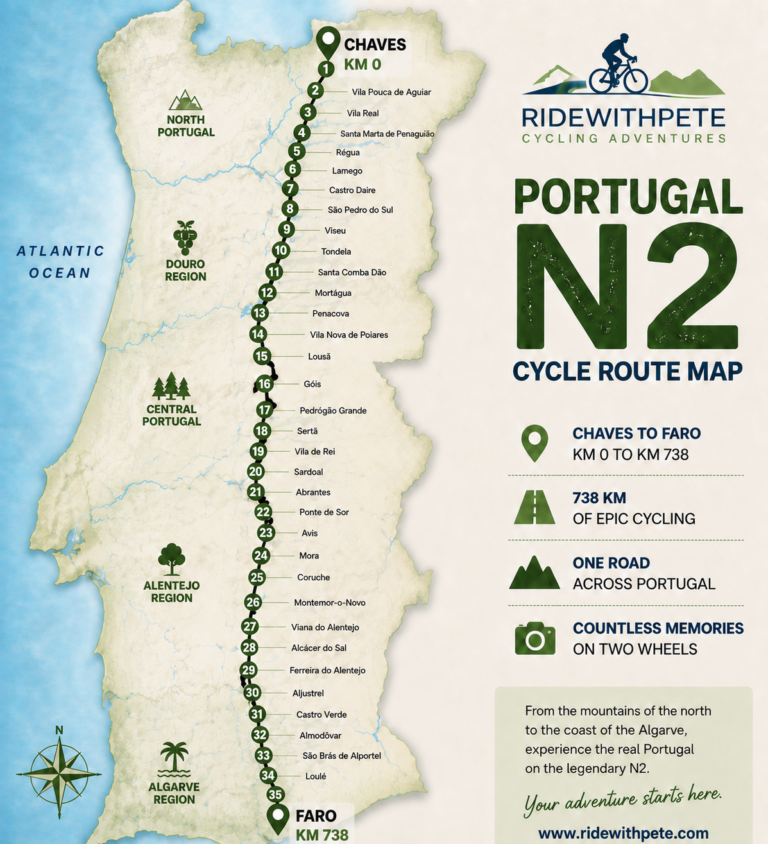
Portugal’s N2 runs 738 km from Chaves to Faro, crossing mountainous terrain, rolling countryside and much flatter sections as it works south through the country. The official N2 organisation itself describes the route as ranging from twisting mountain roads to extensive plains. rotan2.pt
That variety makes bike choice important.
But perhaps not for the reasons you might think.
Is a road bike best for the N2?
For most cyclists, yes.
The N2 is a paved road, so if your intention is to follow the road from Chaves to Faro, there’s no requirement for a mountain bike or gravel bike.
A conventional road bike is perfectly suited to the job.
But if I were choosing specifically for a seven-day N2 ride, I’d probably favour an endurance road bike over an aggressive race bike.
Why?
Comfort.
An aero position that feels fantastic during a fast two-hour Sunday ride can feel very different after several consecutive days in the saddle.
Endurance bikes generally provide a slightly more relaxed riding position while remaining proper road bikes capable of climbing, descending and covering distance efficiently.
That makes them particularly well suited to something like the N2.
Do you need a carbon bike?
Absolutely not.
A good aluminium road bike can cycle the N2 perfectly well.
Carbon can reduce weight and potentially improve comfort, but nobody reaches Faro and discovers their ride doesn’t count because their frame wasn’t carbon fibre.
If you already own a reliable aluminium road bike that fits you properly and you’re comfortable riding it for long distances, I wouldn’t buy a new bike purely because you’re coming to Portugal.
The same principle applies to expensive wheels, electronic gears and other upgrades.
They’re nice to have.
They’re not prerequisites.
For seven consecutive days of cycling, fit, comfort and reliability matter much more than prestige.
What gearing do you need for the N2?
This is where I’d pay much more attention.
The N2 isn’t flat.
The northern part of the journey in particular includes substantial climbing, and there is plenty more elevation waiting further south.
More importantly, you’re not tackling those climbs with completely fresh legs every morning.
A gear that feels manageable on a one-day ride can become much less friendly after several consecutive days of cycling.
For most recreational road cyclists, I’d favour climbing-friendly gearing rather than a race-oriented setup.
A compact 50/34 chainset paired with something around an 11-32 cassette is a sensible starting point, and some riders will be happier with an even easier lowest gear.
Other modern drivetrain combinations can achieve the same thing.
The exact numbers aren’t what matter.
The principle is:
give yourself a low enough gear to climb comfortably without repeatedly grinding at a cadence you can’t sustain.
There are no prizes for cycling the N2 in an unnecessarily large gear.
Your knees will certainly not award you one.
Don’t choose gearing for Day 1
This deserves its own section because it’s an easy mistake to make.
When preparing for a multi-day ride, don’t ask:
“Can I climb this gradient in this gear?”
Ask:
“Will I still want to climb this gradient in this gear after several days and hundreds of kilometres?”
That’s a much better question.
The cumulative nature of the N2 is one of the things that makes it a challenge.
If you’re unsure how demanding the complete ride is, our Portugal N2 Cycle Route: Complete Cyclist’s Guide gives a much broader overview of what to expect between Chaves and Faro.
Choose your gearing for the entire journey, not for the first climb.
What tyres should you use?
For a road-bike N2 ride, I’d be perfectly happy on modern road tyres somewhere around 28 mm, assuming your bike accommodates them.
Some riders may prefer 30 or 32 mm for additional comfort.
There isn’t one compulsory width.
What I wouldn’t do is arrive with ultra-narrow, fragile tyres chosen purely because they’re marginally faster on perfect tarmac.
Over 738 km, comfort and reliability matter.
A slightly wider modern road tyre can provide a useful combination of rolling efficiency, grip and comfort without turning your road bike into something sluggish.
Whatever width you choose, start the trip with tyres in good condition.
Beginning a week-long cycling journey on a rear tyre that’s already squared off and approaching the end of its life is false economy.
Tubeless or inner tubes?
Either can work.
If you already use tubeless successfully and know how your setup behaves, there’s no reason to abandon it for the N2.
Likewise, there is nothing wrong with conventional inner tubes.
What matters more is that you understand your own equipment.
If you run tubeless, you should still know what to do if a puncture doesn’t seal.
If you use tubes, carry the normal equipment required to change one.
Don’t make the N2 the first ride where you discover that you have no idea how to remove your wheels or that the spare tube you’ve carried for two years doesn’t actually have the right valve length for your rims.
Disc brakes or rim brakes?
Both can get you from Chaves to Faro.
Hydraulic disc brakes offer excellent braking performance and are particularly reassuring on longer descents and in wet conditions.
But that doesn’t mean somebody with a well-maintained rim-brake road bike needs to replace it.
If your bike has rim brakes that you use confidently at home, the braking surfaces are in good condition and everything is properly maintained, they’re perfectly capable of road cycling.
The important part is condition and familiarity.
A week before the N2 isn’t the ideal time to completely change your braking system and discover that your new bike handles differently on descents.
What about an e-road bike?
An e-road bike can make a great deal of sense on the N2.
And no, I don’t consider it cheating.
The point is to experience the journey across Portugal, not satisfy somebody else’s arbitrary rules about how much suffering is required.
E-road bikes can be particularly useful when couples or friends have significantly different fitness levels.
Instead of one rider repeatedly waiting at the top of every climb while the other destroys themselves trying to keep up, assistance can help bring the group closer together.
It can also make the N2 accessible to riders who might otherwise find seven consecutive days beyond what they’d comfortably enjoy.
There are additional considerations — particularly battery range, charging and the weight of the bike — but there’s nothing inherently wrong with choosing electric assistance.
You’re still riding the N2.
Could you ride the N2 on a gravel bike?
Yes.
A gravel bike with suitable tyres can handle the N2 perfectly well.
Whether it’s the best choice depends on what else you intend to do.
If you’re staying on the paved N2 throughout, a road bike will generally be lighter and more efficient.
But if your wider Portugal trip includes unpaved riding or you simply find your gravel bike more comfortable, there’s no reason you can’t use it.
You don’t need gravel capability specifically for the N2 itself.
What about a mountain bike?
Could you cycle the N2 on a mountain bike?
Of course.
People undertake long-distance challenges on all sorts of bicycles.
But if you’re choosing a bike specifically for this ride, a mountain bike — particularly a heavy full-suspension bike with large off-road tyres — wouldn’t be my first choice.
You’re spending hundreds of kilometres riding on tarmac.
Suspension and aggressive mountain-bike tyres add weight and rolling resistance that you simply don’t need for the route.
Interestingly, one rider who completed the N2 in 2025 did exactly that on a 150 mm travel mountain bike fitted with slick tyres. It worked — but even the discussion around the trip recognised that a lighter road or gravel setup would have been more efficient. Reddit
That’s a useful reminder:
You can ride the N2 on almost anything.
That doesn’t mean every bike is equally well suited to it.
Comfort matters more than weight
If I could choose between:
a 7 kg race bike that gives me back pain after four hours
and
a 9 kg endurance bike that I can comfortably ride all day
I know which one I’d take across Portugal.
The second one.
Bike weight certainly matters when you’re climbing, but the difference between those two bikes is tiny compared with the effect of spending seven days uncomfortable.
Before the trip, make sure you’re happy with:
- saddle height;
- saddle position;
- reach to the bars;
- handlebar position;
- cleat position;
- and the saddle itself.
And make those decisions before you arrive in Chaves.
The N2 isn’t where you want to conduct a seven-day bike-fit experiment.
Should you change your saddle before the N2?
Not if your current saddle works.
A new saddle isn’t automatically a better saddle.
If you’ve already ridden long distances comfortably on your existing setup, I’d be very reluctant to change it immediately before the trip.
The same applies to shoes and cleats.
New equipment can be tempting when preparing for a big cycling adventure.
But tested equipment has one enormous advantage:
you already know it works.
Get the bike serviced before travelling
This is much more important than buying upgrades.
Before cycling the N2, I’d want the bike checked properly.
Pay particular attention to:
- tyres;
- brake pads;
- chain wear;
- cassette condition;
- gear shifting;
- wheel condition;
- bearings;
- cables or hydraulic systems;
- and anything that has recently started making an interesting noise.
If something is already nearly worn out, replace it before the trip.
Seven consecutive days isn’t the time to squeeze the final 300 km out of a component.
What spares should you carry?
You don’t need to turn your road bike into a mobile workshop.
But you should be capable of dealing with basic roadside problems.
At minimum I’d want access to:
- spare inner tube, even if running tubeless;
- tyre levers;
- inflation — pump or CO₂ according to preference;
- suitable multitool;
- puncture repair appropriate to your setup;
- quick link suitable for your chain;
- and any small bike-specific item that would be difficult to replace.
We’ll go much further into clothing, spares and personal equipment in our upcoming What to Pack for Cycling Portugal’s N2 guide.
The important principle is to carry enough to deal with realistic problems without carrying half a bicycle shop.
Bring your own bike or hire one?
There are good arguments for both.
Your own bike has one huge advantage:
it’s your bike.
You know the fit, handling, gearing and saddle. There shouldn’t be many surprises.
The downside is getting it to Portugal.
Flying with a bike can mean a bike box, airline charges, assembly at the other end and the inevitable nervous wait at baggage reclaim.
Hiring removes much of that hassle, but you’ll be spending seven days on an unfamiliar bicycle.
If you hire, make sure the bike is reserved well in advance and that the supplier knows your correct size and requirements.
Don’t assume you’ll arrive in Portugal and simply find the perfect road bike waiting in your size.
The best bike is the one you can comfortably ride for seven days
That’s really the answer.
You don’t need the lightest bike.
You don’t need electronic gears.
You don’t need carbon wheels.
You don’t need whatever professional teams are currently riding.
You need a bike that:
fits you, is reliable, climbs comfortably, stops confidently and remains comfortable after several hours in the saddle.
If your current road bike does all of those things, there’s a very good chance you already own the right bike for the N2.
Guided or self-guided?
Bike choice matters whichever way you tackle the route.
If you’d rather have the wider trip organised around the riding, you can see how our Guided N2 Cycling Tour works and check the latest N2 Tour Dates and Availability.
If you’d rather ride independently, our N2 Self-Guided option is designed for cyclists who want to tackle the route themselves with the route information already prepared.
Whichever option you choose, don’t let bike-shopping become more complicated than the ride itself.
Prepare the bike properly.
Choose sensible gearing.
Make sure you’re comfortable.
Then concentrate on the 738 km between Chaves and Faro.